Water heater and appliance leak cleanup in Knoxville
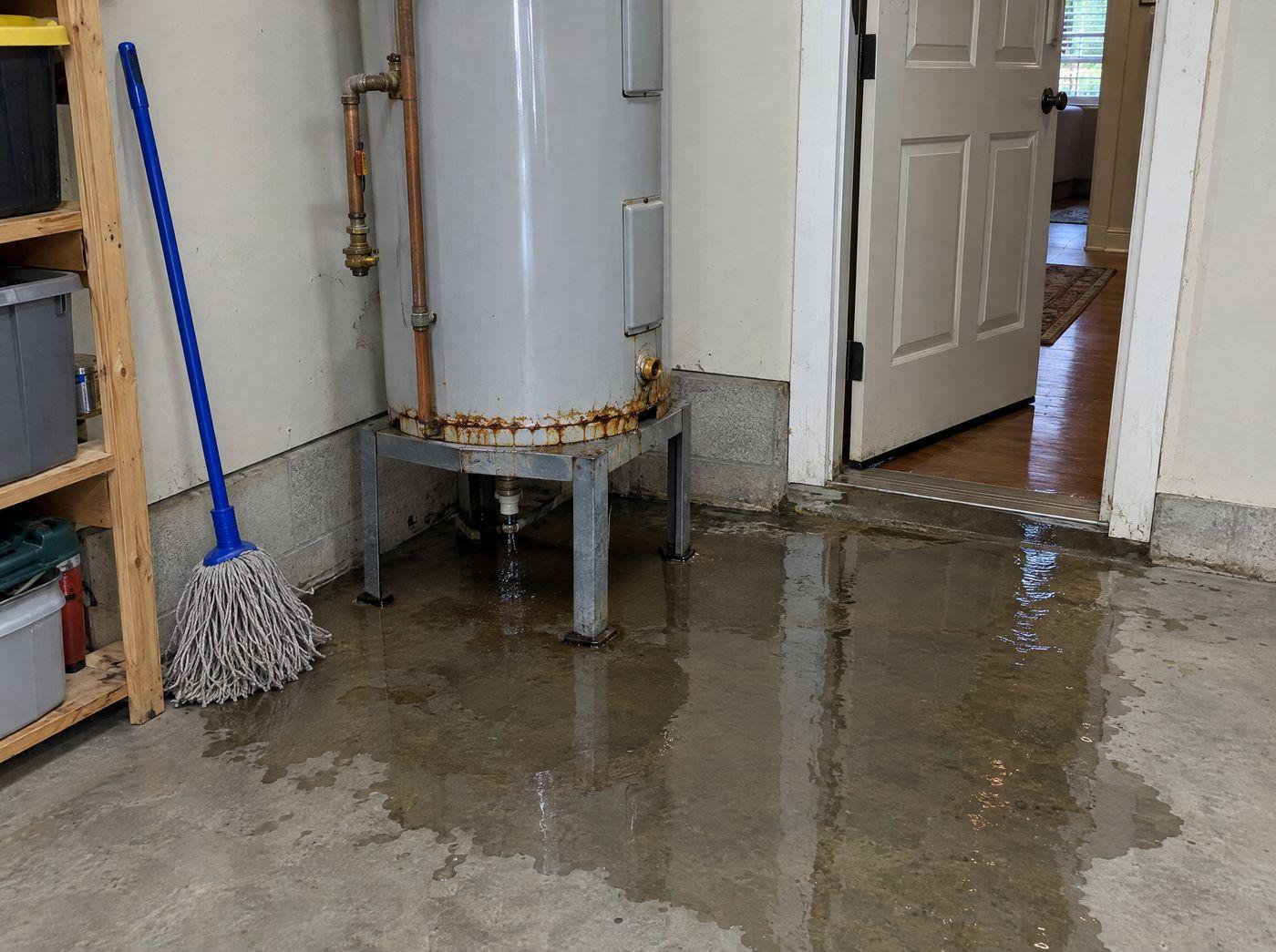
Appliance leaks start where nobody is looking: behind the washer, under the dishwasher, inside the cabinet, or at the bottom of a water heater in a closet or garage. A tank can also fail all at once and release its full contents. Because the water starts low and out of sight, it often runs under flooring and into the crawl space before anyone sees it.
Cabinets and floors are where the damage builds. Particleboard cabinet bases swell, and water trapped under laminate or hardwood can't dry on its own. Fast extraction and drying is the difference between drying those materials and replacing them.
Water category: Category 1 from supply lines; Category 2 from washer or dishwasher drain water
1Turn off the water to the appliance. For a water heater, close the cold-water valve on the pipe feeding the tank, then turn off the gas or the breaker.
2Don't touch a water heater's drain valve or pipes until it cools. The water can scald.
3Pull the plug on the washer, dishwasher or fridge if you can reach it without standing in water.
4Check the crawl space under the leak if you have one. Water often ends up there.
5Note the appliance's make, model and age, and take photos for your records.
What a water heater & appliance leaks job should include
Use this as a checklist against the written scope the company gives you. If a step is missing, ask why.
Step 1
Find the edges
Moisture meters and a thermal camera show how far water spread under flooring, cabinets and into the crawl space.
Step 2
Extract
Water is pulled out of carpet, pad and from under floating floors so it stops spreading.
Step 3
Dry cabinets and floors
Toe kicks may come off to dry under cabinets, and floor-drying mats can pull water from hardwood.
Step 4
Dehumidify
Air movers and dehumidifiers stay on until the wood, drywall and subfloor test dry.
Step 5
Write it up
You get photos, readings and a written list of what was done.
Knoxville facts for this problem
In Knox County, a home improvement license is required for residential remodeling projects from $3,000 to $24,999, and a contractor's license from $25,000. That applies to rebuilding cabinets and floors after a leak, so ask for the license number before work starts.
The City of Knoxville's resource directory lists Knoxville Utilities Board (KUB) at 865-524-2911.
West Knox County is served by First Utility District, (865) 966-9741, whose district runs from the Loudon County line east to Gallaher View Road and from north of I-40/75 south to the Tennessee River.
A sudden appliance leak is generally treated as accidental discharge of water, while the failed appliance itself usually isn't covered. Slow leaks that went on for weeks are commonly excluded as repeated seepage. Your policy wording decides it.
General information, not advice about your policy. Only your insurer decides coverage.
What size job needs a licensed contractor in Knox County?
In Knox County, Tennessee requires a home improvement license for residential remodeling projects from $3,000 to $24,999, and a contractor's license for projects of $25,000 or more. Ask for the license number before work starts and check it on the state's license search.
Will a wet hardwood floor dry out or need replacing?
Often, if drying starts quickly. Floor-drying mats and dehumidifiers pull water out of the boards and subfloor. Boards that cupped badly or stayed wet for days may need replacing.
Should I replace washer hoses?
Rubber hoses are a common failure point. Braided stainless hoses are an inexpensive upgrade, and many manufacturers recommend replacing hoses every five years.
Talk to a company that serves your ZIP
Your call is connected with an independent local company. It visits, measures and gives you a written scope; you decide whether to go ahead. Callers pay MetaBloom Ventures LLC nothing.