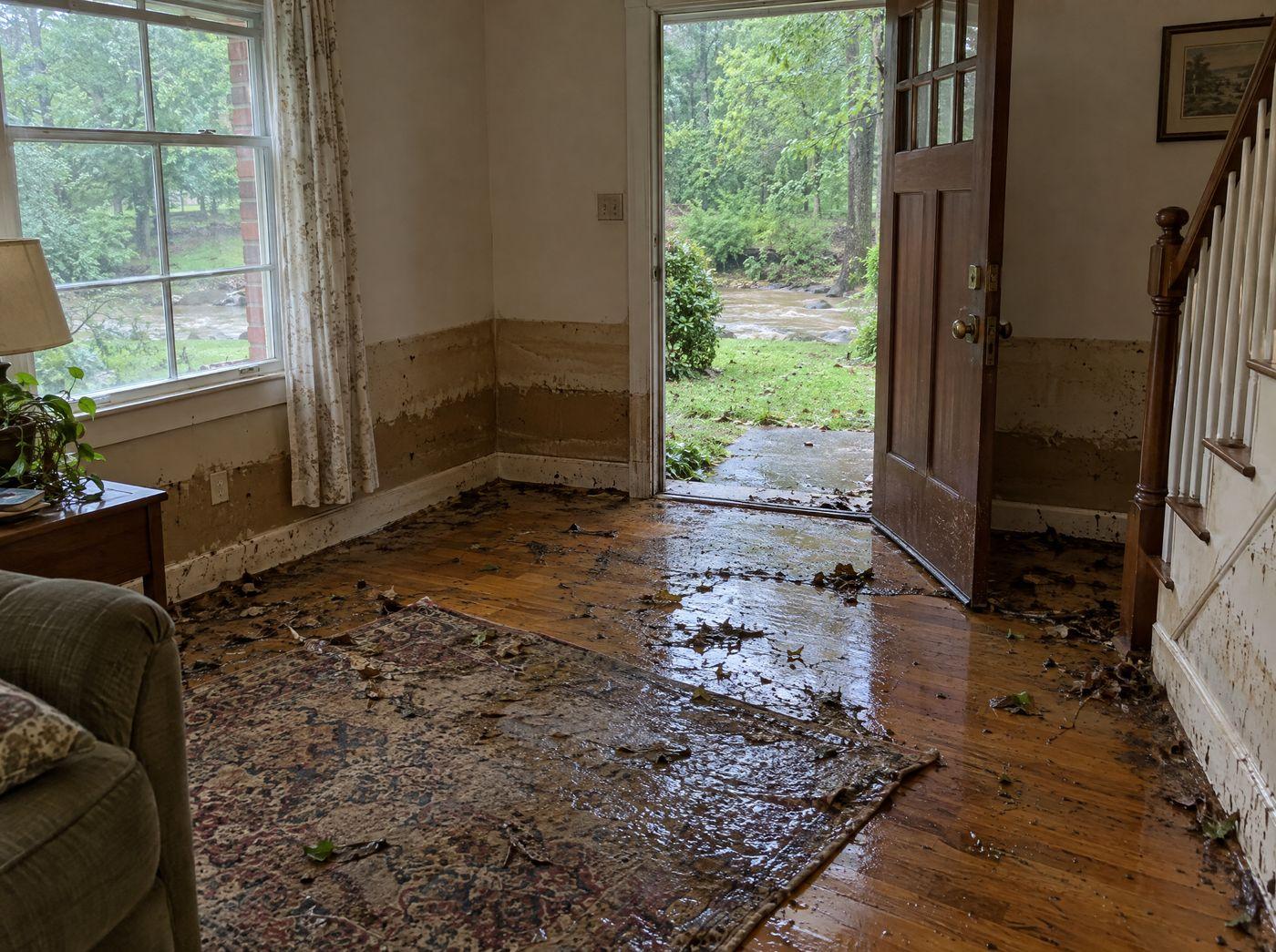
Knoxville's flooding is usually fast and local. A thunderstorm parks over one part of town, the small creeks and storm drains fill within an hour, and water reaches yards, garages and lower floors before the rain stops. The city has 29 watersheds, and a three-year city assessment found 23.4 percent of its stormwater infrastructure in fair, poor or failing condition.
Water from outside is treated as contaminated from the start. The state lists several Knoxville creeks, including First, Second, Third and Goose creeks, under bacteriological advisories. Carpet, pad, insulation and the lower part of drywall that flood water touched usually come out, and everything is cleaned and disinfected before drying starts.
Water category: Category 3 (contaminated water)
1Rising water means leave for higher ground and call 911. Never walk or drive through moving water.
2Don't use lights or appliances that got wet. If water reached outlets or the panel, keep the power off.
3Keep children and pets away, and wear boots and gloves if you must go in. Flood water can carry sewage.
4Take photos of every room and the water line on the walls for your records.
5Report flooding from a street drain or manhole to the city or KUB so they can check the system.
What a flash floods & creek water job should include
Use this as a checklist against the written scope the company gives you. If a step is missing, ask why.
Step 1
Safety check and pump-out
Someone checks the wiring and the structure first, then pumps out what's standing.
Step 2
Mud and debris removal
Silt, mud and soaked materials are removed and bagged.
Step 3
Flood cut
Drywall is usually cut above the water line so the wall cavity can be cleaned and dried.
Step 4
Clean and disinfect
Framing, floors and anything kept are washed, then treated with an EPA-registered disinfectant.
Step 5
Dry and measure
Dehumidifiers and air movers run with daily readings until framing and floors read dry.
Knoxville facts for this problem
The City of Knoxville is rated Class 6 in FEMA's Community Rating System, which the city says brings NFIP premiums in the city down 20 percent. Knox County, outside the city, has a CRS score of 9. Flood maps for both are on KGIS.
February 28, 2011 is the loss date with the most NFIP flood claims in Knoxville's residential ZIP codes: 60 claims across 10 ZIPs, with $1,803,983 paid.
Storms trained over the same areas for about three hours. The Knoxville Water Plant observer recorded 4.08 inches, radar estimated up to 6 inches in parts of Knox and Loudon counties, roads closed, people were evacuated and flooding around Neyland Stadium delayed kickoff.
Knoxville has 29 watersheds, and a three-year city assessment found 23.4 percent of its stormwater infrastructure in fair, poor or failing condition. In August 2026 the city held four public meetings to hear from property owners about flash flooding.
The City of Knoxville is rated Class 6 in FEMA's Community Rating System, which the city says lowers NFIP flood insurance premiums there by 20 percent.
A standard homeowners policy does not cover flooding from outside the house. That takes a National Flood Insurance Program policy or a private flood policy, and new NFIP policies generally take effect after a 30-day wait. Because the City of Knoxville is rated Class 6 in FEMA's Community Rating System, the city lists NFIP premiums for property inside city limits as 20 percent lower.
General information, not advice about your policy. Only your insurer decides coverage.
Check the FEMA flood maps on KGIS or the FEMA Map Service Center. Knoxville's current Flood Insurance Rate Maps were updated after a Tennessee Valley Authority flood study, with an index map effective August 5, 2013. Many flash floods here happen outside mapped flood zones.
What happened in the September 2006 Knoxville flood?
On September 23, 2006, storms repeatedly crossed the same areas between Chattanooga and Knoxville. The National Weather Service recorded 4.08 inches at the Knoxville Water Plant observer site, radar estimated up to 6 inches in parts of Knox and Loudon counties, roads were closed, people were evacuated, and flooding around Neyland Stadium delayed the start of the football game.
Can anything be saved after flood water gets in?
Hard things like solid wood, metal, glass and plastic usually clean and disinfect fine. Mattresses, upholstered furniture, carpet pad and most paper soaked by flood water generally can't be.
Talk to a company that serves your ZIP
Your call is connected with an independent local company. It visits, measures and gives you a written scope; you decide whether to go ahead. Callers pay MetaBloom Ventures LLC nothing.