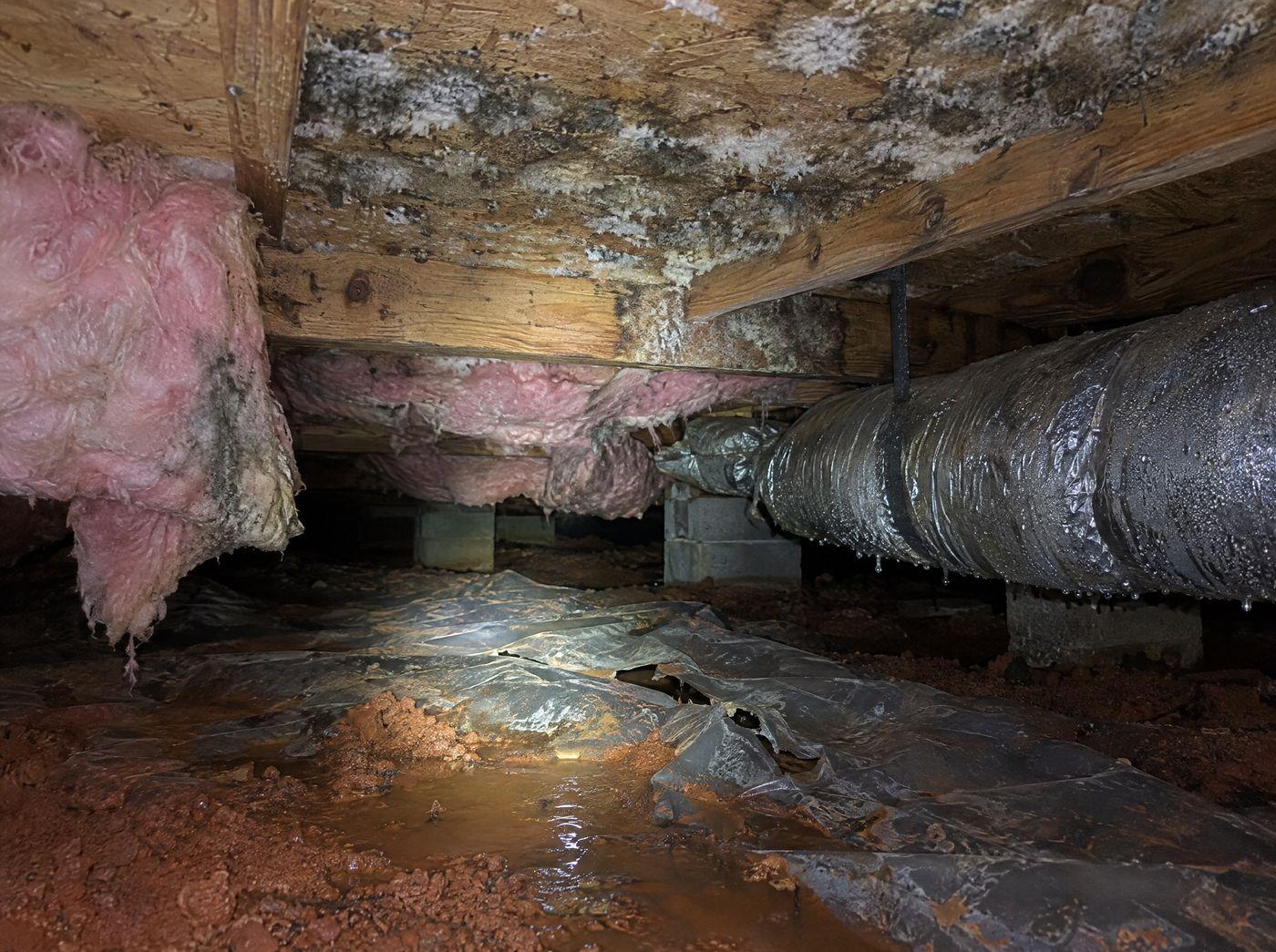
A lot of Knoxville homes sit over a crawl space instead of a basement or a slab. That space sits right where water collects. Rain runs toward the foundation on sloped lots, a downspout empties beside the wall, a supply line drips for months, or the summer air coming through the vents meets cool ductwork and condenses. Wood that stays damp grows mold, and the musty smell comes up through the floor.
Removing the mold is only half the job. If the water keeps coming, the mold comes back. A proper crawl-space job finds the source, removes wet insulation and debris, cleans or removes moldy wood surfaces, and dries the space before anyone talks about sealing it.
Water category: Category 2 or 3 if storm water or a drain line got in; mold is a separate assessment
1Don't crawl into standing water if there are wires or a pump down there. Turn off that circuit from a dry spot.
2Look for the source from the access door: a dripping line, water running in from one wall, or a wet duct.
3If water is running from a supply line, close the main shutoff.
4Keep the crawl-space door closed so you aren't pulling damp air into the house.
5Take photos from the access door for your records.
What a crawl space water & mold job should include
Use this as a checklist against the written scope the company gives you. If a step is missing, ask why.
Step 1
Find the water
Moisture readings on joists and subfloor, a look at grading, gutters and plumbing, and a check of the ductwork for condensation.
Step 2
Remove standing water and debris
Water is pumped out and wet insulation, old vapor barrier and debris are removed and bagged.
Step 3
Contain and clean
Moldy surfaces are cleaned or removed with HEPA vacuums and air filtration so spores don't move into the house.
Step 4
Dry the wood
Dehumidifiers run until the joists and subfloor read dry. Wood that stays wet will grow mold again.
Step 5
Fix the cause
The written scope should say what will stop the water: plumbing repair, drainage, gutter work, duct insulation or a new vapor barrier.
Knoxville facts for this problem
Many Knoxville houses sit on hillside lots over a crawl space, and summer air here is humid enough to sweat on cool ductwork. A crawl-space job should say in writing what will keep water out once the mold is gone.
July is Knoxville's wettest month in the 1991-2020 normals, at 5.25 in. of the year's 51.93 in..
The city's ten wettest years on record include 2013 (69.30 inches), 2020 (66.10 inches), 2019 (64.29 inches) and 2018 (61.37 inches), four of them in the last fifteen years.
Tennessee lists mold remediation as a specialty contractor classification (S-F Mold Remediation). A contractor's license is required for projects of $25,000 or more, and in Knox County a home improvement license is required for residential remodeling projects from $3,000 to $24,999. Ask which license the company holds and look it up on the state's license search.
Policies usually treat a sudden plumbing leak differently from groundwater, seepage, condensation or mold that built up over time, which many policies limit or exclude. Read the water, mold and seepage sections of your policy before deciding anything.
General information, not advice about your policy. Only your insurer decides coverage.
Why do Knoxville crawl spaces get so wet in summer?
Warm, humid outdoor air enters through the vents and meets cooler surfaces such as ductwork and the underside of the floor. When those surfaces are colder than the air's dew point, water condenses on them. Our weather page shows today's dew point at McGhee Tyson Airport.
Does Tennessee require a license for crawl space mold work?
Tennessee licenses mold remediation as a specialty contractor classification (S-F Mold Remediation) for projects of $25,000 or more. In Knox County, a home improvement license is required for residential remodeling projects from $3,000 to $24,999. Ask which license the company holds and look it up on the state's license search.
Is encapsulation the same as mold remediation?
No. Encapsulation seals the crawl space with a heavy liner and controls humidity. Remediation deals with mold that is already there and the water that caused it. Encapsulating over wet wood or active mold traps the problem.
Talk to a company that serves your ZIP
Your call is connected with an independent local company. It visits, measures and gives you a written scope; you decide whether to go ahead. Callers pay MetaBloom Ventures LLC nothing.